| LEARN: Animals Food Humane Farming? Environment Conscience SHARE: Family & Friends Screenings Classrooms SUPPORT: Overview Films & Programs New Languages Teachers Culture-Builders |
| LEARN: Animals Food Humane Farming? Environment Conscience SHARE: Family & Friends Screenings Classrooms SUPPORT: Overview Films & Programs New Languages Teachers Culture-Builders |
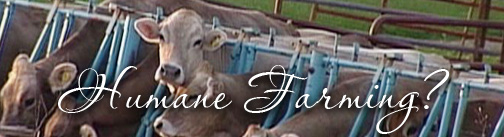
When a person who consumes animal products begins to learn more about who farm animals are and what actually happens to them, it can be distressing. A natural response is to want to do something to make things better. But what? The animal-using industries exploit this sympathetic instinct by promoting the idea that there are ways to produce animal products that could be fairly described as compassionate or respectful or humane. Unfortunately, even some misguided animal advocacy organizations help fortify this myth (see Humane Myth). They encourage those with a newfound concern about the well-being of animals to switch to pricier animal products labeled "humane," "cage-free," "free-range," "organic," "grass-fed," etc., suggesting this is a "step in the right direction." But is the public being misled?
When even slaughter itself is labeled as "humane," it's easy to see there is a problem. This and other misleading terminology serve to distract from a basic truth: whatever techniques are used, and whether animals are raised and killed in a large-scale industrial system or on a small scale operation, there is undeniable violence associated with taking the life of anyone against their will. Not to mention the social deprivation, confinement, reproductive manipulation and arbitrarily shortened life span that inevitably accompany the exploitation of animals on a scale needed to meet the demand created by vast numbers of people choosing an animal product-based diet.
The truth is that all styles of animal agriculture, when practiced at the scale needed to feed animal products to substantial numbers of people, consume vast amounts of water, land and other resources while contributing to deforestation, soil erosion, habitat destruction and a loss of biodiversity. The use of enormous tracts of arable land to grow feed for animals within the agricultural system is connected with several tragic injustices, including 1) making it more difficult for those in less wealthy countries to get access to the farmland needed to feed themselves, 2) contributing to deforestation as more and more land is cleared, 3) dramatically decreasing the habitat available for free living animals, and 4) damaging the biodiversity upon which our collective survival depends.
Livestock & Climate Change, a report produced by two researchers with the World Bank and published by Worldwatch Institute, has documented that over 51% of all global warming impact is being caused by animal agriculture.
Those who make the choice to move away from participating in the exploitation and killing of animals do so in many different ways. Some make a complete change overnight, immediately ceasing the consumption of animal products and/or refraining from using clothing and other goods made of animal-derived products. Other people make a gradual transition by systematically decreasing their use of animal products, either by not eating any animal products on certain days of the week or by eliminating use of certain types of animal products one by one, until there are none left to eliminate. At the same time, the adventure of discovering nonviolent alternatives brings to many people significant personal benefits, such as improved health, a sense of being at peace and in greater harmony with nature, and a deeper connection with other humans as well as the animals with whom we share our world.
A commitment not to participate in exploitation may be more helpfully viewed as an ongoing journey, and less like a final destination. For example, the vast scale and pervasive use of products derived from animal exploitation, not just for food and clothing, but for chemical products and all manner of industrial goods, means that it takes time to learn what does and does not contain animal-derived ingredients, and to then find alternatives. Sometimes it even means being a part of creating new alternatives oneself. People who have walked this path for many years point out that it is not about achieving perfection, but about moving ever closer to an ideal. This ongoing effort is seen by some as an expression of mindful solidarity with those whose tragic misfortune is to be needlessly used and killed for human purposes. Others have described it as a form of meditation on compassion and justice, or a practice that helps us grow in our capacity to be aware of how we are affecting others and how we can shift our lives in a direction of taking a deeper level of responsibility, doing less and less harm, and being of greater and greater service to others.
Copyright © 2016 Tribe of Heart Ltd.